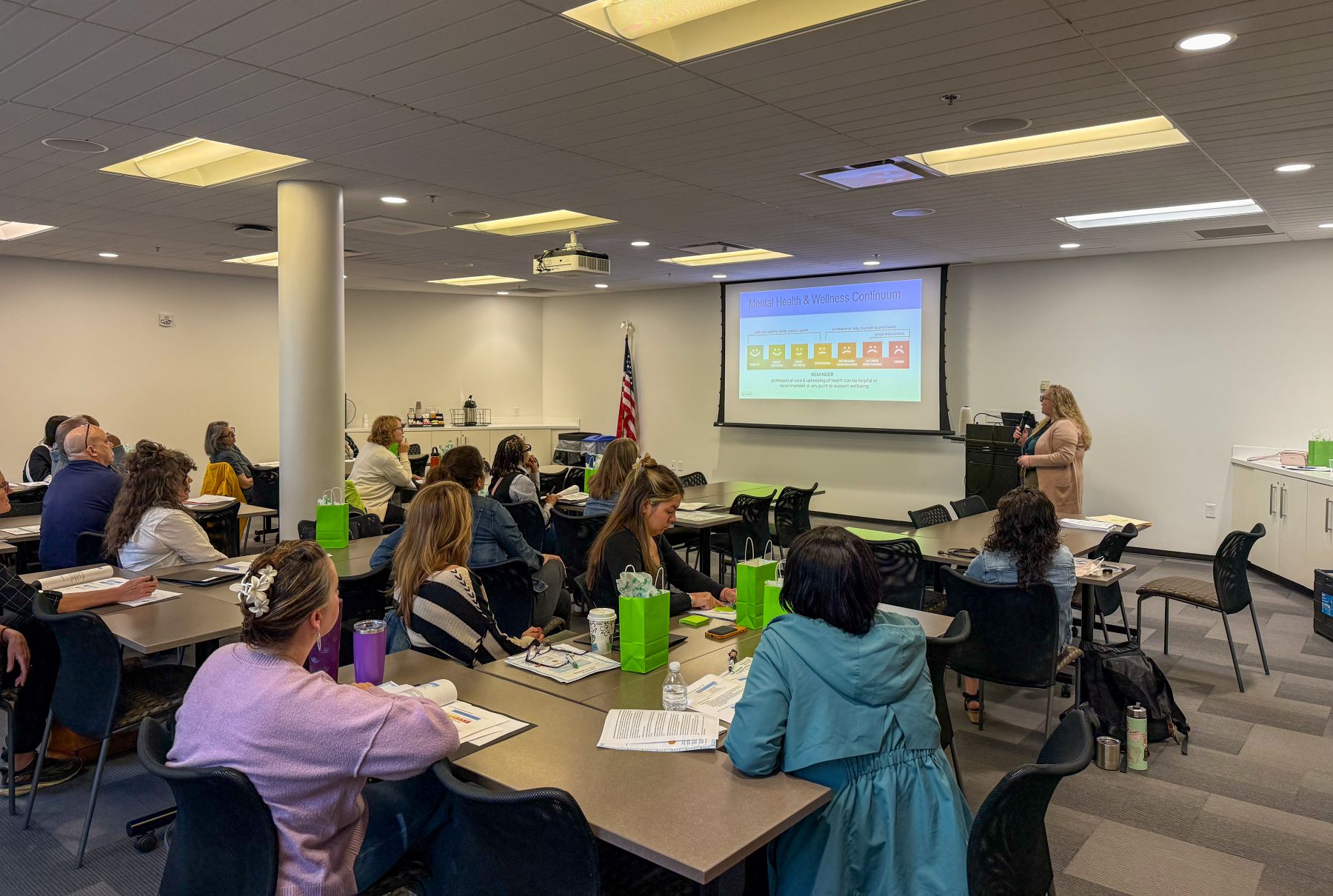
A mental health awareness training developed at 妖姬直播 State University is now reaching communities in 26 states 鈥� and the researchers behind it are working to ensure it reaches many more.
The A.I.D. training 鈥� which stands for Awareness, Interaction and Direction 鈥� was created in 2019 by the Center for Public Policy and Health in the College of Public Health. The training teaches participants how to recognize signs of mental distress, engage in compassionate and effective conversations with someone who may be struggling and connect that person with the resources they need.
Since fall 2024, the center has offered a train-the-trainer model, equipping instructors at organizations across the United States to deliver the training in their own communities. To date, the program has reached more than 80 organizations and trained more than 200 instructors nationwide.
鈥淭he center鈥檚 A.I.D. training is an effective way to educate individuals about how to recognize when someone may be struggling with their mental health,鈥� said Deric R. Kenne, Ph.D., professor and director of the Center for Public Policy and Health. 鈥淎.I.D. gives individuals the confidence to interact with those experiencing distress and to respond in a supportive and informed way to connect them with services and supports.
More importantly, the A.I.D. training can be completed in as little as 60 minutes and provides training to communities free of charge. The A.I.D. train-the-trainer sessions 鈥渆xpand the overall impact of A.I.D. by equipping community leaders and frontline professionals to provide A.I.D. in their communities, further expanding a rapidly growing network to support mental health.鈥�
A.I.D. is evidence-based training. A was published by the center in 2024 on the effectiveness of the A.I.D. training, underscoring 妖姬直播 State鈥檚 role as a top-tier, R1 research university committed to research that sparks meaningful discoveries and betters communities near and far.
One of the program鈥檚 greatest strengths is its adaptability 鈥� reflecting 妖姬直播 State鈥檚 commitment to delivering programs that meet people where they are. Although designed for a general audience, the training can be tailored to meet the needs of specific populations. The center has reached law enforcement officers, educators, rural communities and tribal communities, among others.
鈥淓ven though we developed the A.I.D. training with the general population in mind, we have aspects of the training that people can tailor to fit their own specialized population,鈥� said Kayla Varney, research associate in the Center for Public Policy and Health. 鈥淚 think that has really helped to grow the interest and effectiveness of A.I.D.鈥�
In addition to the 60-minute core session, there is a 90-minute version that adds a self-care module. The self-care module addresses the benefits of tending to one鈥檚 mental well-being, common misconceptions and practical strategies participants can weave into their daily routines.
鈥淲e spend the first 60 minutes talking about how we can be there to support others,鈥� Varney said. 鈥淲hen we shift to talking about self-care, we talk about how we can continue to support ourselves so we can best and most effectively continue to help others.鈥�
Specialized versions of the training for older adults and adolescents have also been developed, and a Spanish-language version is currently in the pilot stage. An asynchronous, self-paced online version is available as well, allowing participants to complete the training without a live instructor. Any 妖姬直播 State faculty, staff or students interested in completing the online training can contact Kayla Varney (kmarker@kent.edu) to enroll.
Recruitment for the train-the-trainer program draws largely from organizations funded through the Substance Abuse and Mental Health Services Administration, known as SAMHSA, as well as word of mouth from trained instructors who pass the program along to their peers.
From Classroom to Community: A.I.D. Training in Action
For Jay Hays, Ph.D., academic program director in the College of Nursing, the A.I.D. training has become more than a professional development exercise 鈥� it has reshaped how he engages with students, colleagues and community members every day.
Hays encountered his first mental health awareness training (MHAT) in 2017 as a participant in one of the center鈥檚 federally funded MHAT grants.
鈥淚 was astounded by how it really did translate all that research into a practice format,鈥� said Hays, whose doctorate is in sociology with a focus on the sociology of mental health. 鈥淚t was strong evidence-based practice.鈥�
He later became certified to deliver the A.I.D. training around 2022 or 2023, seeing it as a more feasible solution 鈥� a one-hour, evidence-based MHAT option built on mental health principles packaged for broader, faster reach.
Hays spoke with 妖姬直播 State Today about how the A.I.D. acronym itself guides how he now moves through his professional and personal life.
That impact has extended well beyond campus. As a board member of the Buckeye Council of Scouting America, based in Canton, Ohio, Hays began delivering the A.I.D. training on adult leadership weekends. The response was strong enough that he was invited to train summer camp staff 鈥� and the work has since expanded to councils across Ohio.
鈥淭his summer I think I鈥檓 going to three different summer camps around Ohio to train people in this training, and I go to adult trainings all over the state of Ohio now to deliver this,鈥� Hays said.
Hays expressed hope that the training could eventually count toward 妖姬直播 State鈥檚 Beyond Compliance initiative, which recognizes voluntary professional development activities.
鈥淓verybody I鈥檝e talked to that鈥檚 been through the training has really taken a lot away from it,鈥� he said. 鈥淚鈥檇 love to see more people at the university do it.鈥�
Upcoming Events and How to Get Involved
The center will host a free, virtual community-wide A.I.D. training on April 15 at noon. Open to participants regardless of location, the session will offer the 60-minute core training and is being promoted through the center鈥檚 networks across the country. A train-the-trainer session is also scheduled for March 24.
In May, the center will lead an in-person train-the-trainer session at a mental health symposium hosted by the Northeast Ohio Educational Service Center, an organization that supports school districts throughout the region.
Conversations about mental health have shifted in meaningful ways in recent years, said Diana Patel, Ph.D., project coordinator in the Center for Public Policy and Health. She pointed to a growing openness, particularly among younger generations, toward discussing mental health as a normal and important part of life.
鈥淧eople are more aware of and talking more openly about mental health concerns,鈥� she said. 鈥淭hat鈥檚 really important in breaking the stigma around it, and it helps people get more comfortable seeking out care and talking about how they鈥檙e feeling.鈥�
Register for the April 15 virtual A.I.D. training or learn more about the train-the-trainer program.
To reach the College of Public Health go to /publichealth or the Center for Public Policy and Health at /cpph.
For more information about the train-the-trainer program, contact Diana Patel, Ph.D. at dkingsb2@kent.edu.
