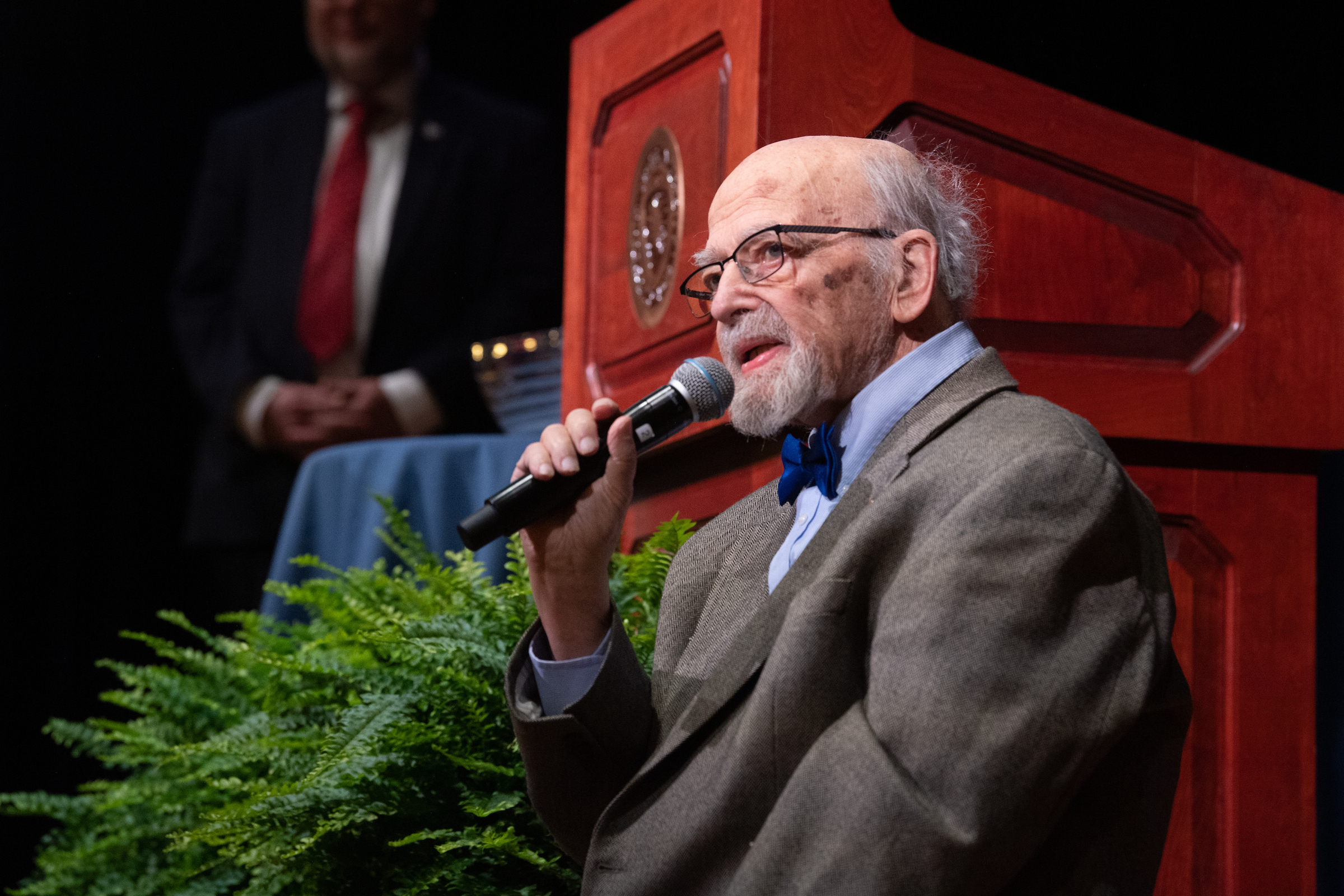
Former students, colleagues and educators from well beyond Ñý¼§Ö±²¥ State University are remembering Professor Emeritus Jerry M. Lewis, Ph.D., for his transformative teaching and significant contributions.
Lewis, 88, a tireless May 4 advocate and longtime sociology professor, died Feb. 11 at his home in Maine.
Across social media and through news coverage, the remembrances share a common thread: Lewis did not just teach sociology — he changed people.
Lewis served as a faculty marshal during the May 4, 1970, shootings and spent the next five decades preserving that history. A recent tribute on Ñý¼§Ö±²¥ State Today drew personal reactions and comments that revealed the breadth of his influence across generations of students.
"Certainly my favorite professor at Ñý¼§Ö±²¥. His May 4 class should have been required for every KSU student." — Susan Bungard, KSU alumna
Extraordinary Classroom Presence
Alumni shared vivid stories of what it was like to sit in Lewis' classroom. His Intro to Sociology course and his May 4 seminar — co-taught for years with the late Thomas Hensley, Ph.D. — were repeatedly described as experiences that reshaped worldviews.
Jason Cody, a senior communications strategist, wrote that Lewis' Intro to Sociology course led him to minor in sociology. "In spring 2000, my senior year and the 30th anniversary of the shootings, I took the May 4 course taught by Dr. Lewis and Thomas Hensley," Cody wrote. "What a transformative few months it was learning from those two men. Really impacted my worldview and taught me invaluable lessons."
Nan Carney-DeBord, a former associate vice president at Denison University in Granville, Ohio, who earned her master's degree at Ñý¼§Ö±²¥ State, said Lewis' Collective Behavior course became a foundation for her 40-year career in college athletics. "So many students' favorite professor, including mine," she wrote. "Peace be with you, Dr. Lewis."
Heather Deeley recalled nearly switching her major after taking Lewis' courses. "Dr. J was so inspiring as a professor, I almost changed my major from journalism to sociology," she wrote. "I took just about every class he offered and became an assistant. He even encouraged me to give a lecture, which helped me build confidence and skills that I use today."
"He hadn't simply lectured about sociology — he made us feel it." — Brad Maguth, professor, University of Akron
Made Sociology Visceral
In a guest column published Feb. 22, at , Brad Maguth, professor of social studies education and director of the H.K. Barker Center for Economic Education at the University of Akron, described Lewis' qualities in a moment that has stayed with him for more than 20 years.
Maguth recalled how, in 2004, Lewis walked into his sociology class at Hiram College — where Lewis was a visiting professor — opened a bag of Doritos and began smashing the chips into his mouth and face, eating loudly and messily with crumbs scattering, as the class sat in confused silence. Only after the discomfort had settled did Lewis explain: The class had just experienced a live demonstration of norms, sanctions and deviance.
"He hadn't simply lectured about sociology," Maguth wrote. "He made us feel it."
Maguth added that Lewis understood education must move beyond information to transformation — that it should challenge assumptions and move, "from the head to the gut."
"In my own classroom today, I often think about that moment," Maguth wrote. "When I ask students to examine norms, question authority or wrestle with uncomfortable truths, I am drawing from his example."
Living Witness to History
Many who commented online connected their memories of Lewis directly to their understanding of May 4.
Maybe none moreso than Rami Daud, an alumnus who now works as a university photographer and spent time with Lewis during several May 4 commemorations.
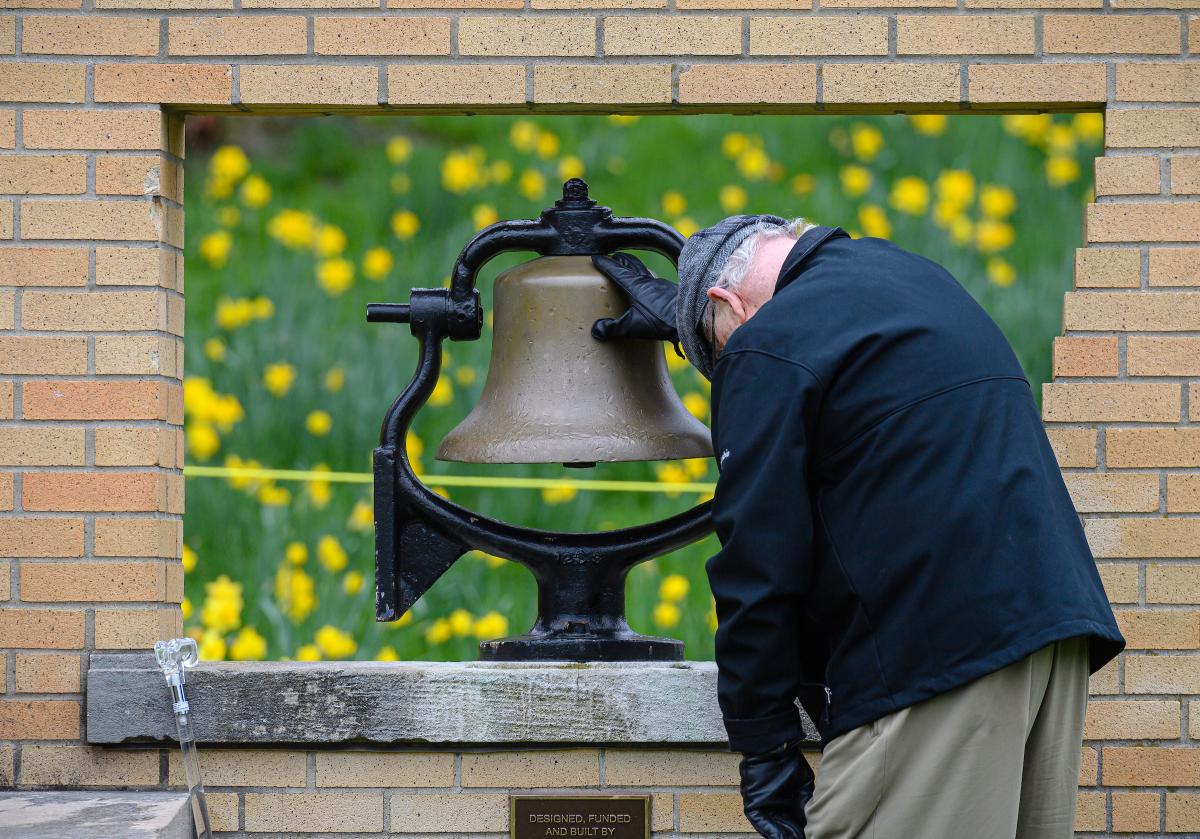
"May 4, 2020, was meant to be the 50th Anniversary Commemoration at Ñý¼§Ö±²¥ State University. Instead, it became one of the quietest and most uncertain days I’ve ever photographed," Daud shared on LinkedIn.
"Of all the images I’ve made in 24 years since I began my journey at Ñý¼§Ö±²¥ State — the last six working for the university — this is the one that stays with me. While the commemoration moved to a virtual format due to COVID, a small group gathered at the May 4 site — including my colleague and friend Bob Christy and me. We had been sent home, and it felt like we’d been away for years. In reality, it hadn’t even been four months.
"At Ñý¼§Ö±²¥ State’s annual observance, the Victory Bell is traditionally rung at exactly 12:24 p.m. — the moment the shootings began in 1970. That year — after being driven to the bell in a golf cart, his health already in decline — Jerry M. Lewis rang the bell 15 times to honor those who were killed or wounded at Ñý¼§Ö±²¥ State on May 4, 1970, and at Jackson State University on May 15, 1970.
"He sat beside the bell with his wife, Diane. The campus was still. The moment felt suspended in time." - Rami Daud
"I had Jerry for Sociology 101 in a lecture hall that felt like it held hundreds of students — and yet it remains one of the most memorable courses I took at the university. He could command a room like few others. He made history feel immediate. Photographing him that day became one of the most meaningful moments of my career.
"Sometimes the work isn’t just about documenting an event. It’s about showing up — and preserving memory when it matters most. I’m grateful I was there."
Another alumnus wrote that walking through the area of the protest and shootings during Lewis' class still affects him decades later.
Tim Viezer, a retired investment officer, recalled Lewis as one of two senior honors thesis advisors who shaped his academic path. "I had the great fortune to have Dr. Jerry Lewis as one of my two senior honors thesis advisors," Viezer . "I learned a great deal from him and enjoyed his sense of humor. I came to Ñý¼§Ö±²¥ seven years after the shootings but saw protests over the building of a gymnasium near the site of those shootings. I became a peace marshal (nonviolent third-party conflict management) trained by Quakers and informed by Dr. Lewis’ insights. I met one of the wounded students and read around a dozen books about May 4, 1970. I am very fond of my time at Ñý¼§Ö±²¥ as an undergraduate and graduate student, but the sadness of those shootings shaped me and stayed with me. If you are touched by an event like that it compels you to work in some way to prevent it from happening again."
Christopher Lobas, a Cleveland architect who worked for a time as an instructor at Ñý¼§Ö±²¥ State, also shared his memories of Lewis via LinkedIn.
"I didn't realize that Ñý¼§Ö±²¥ State stayed closed for six weeks after this event," Lobas wrote. "Decades later, I taught in Taylor Hall, and I stopped at the site often and considered what had happened there."
Roseann "Chic" Canfora, Ph.D., a survivor of the May 4 shootings and now an assistant professor in Ñý¼§Ö±²¥ State's School of Media and Journalism, said the circle of living witnesses is slowly narrowing.
"Each loss is a reminder that those of us who were there will not always be here to tell it," she said. "Jerry understood that. Perhaps better than most."
"Rest in peace, Professor Lewis. Your lessons endure in archives and memorials, in candlelight vigils, and in classrooms where students are still being challenged to defend democracy with courage and conviction today." — Brad Maguth
Lewis Legacy Continues
The Jerry M. Lewis Lecture Series, endowed by alumnus and former Ñý¼§Ö±²¥ State Board of Trustees member Michael Solomon, will continue to honor Lewis' legacy each May 4, as a faculty member is selected annually to present research connected to the May 4 Visitors Center and Special Collections and Archives.
On the 56th anniversary of the May 4 shootings this year, Lewis' influence will be felt as it has been every year since 1971, when he helped to establish the candlelight walk and vigil, rituals that begin the commemoration each May 3 and continue through 12:24 p.m. May 4, the moment the shots were fired.
