妖姬直播

Phishing and Scams

Phishing is a form of social engineering delivered by email. Phishing scams appear to originate from a trusted source to trick you into entering your credentials, revealing personal identifying information (PII), or sending money to them.

The attacker can then use this information to access your accounts, gather additional private information about you in an attempt to steal your identity, and make purchases or apply for credit in your name.

You can learn more about phishing and social engineering by reading the information here.


Phishing Tips

  • Move your mouse over links in emails and it may show a different URL than the one displayed.
  • If you are encouraged to click a link that claims to lead to a legitimate site (such as Amazon), look online for a trusted URL leading to that site instead.
  • Check the sender address to verify that the email comes from an official source.
  • Check for slight mispellings - in the URL, company name, etc. For example, paypa1.com instead of paypal.com.
  • Use additional software - Many browsers have add-ons/extensions/plug-ins that can help detect phishing sites.
  • Be wary of anything that gives a sense of urgency, or states that it requires immediate action.
  • Don't click anywhere in suspicious emails鈥攅ven in what may appear to be white space.
  • Be wary of too-good-to-be-true offers such as free airline tickets or vacation.
  • Don鈥檛 open attachments in unexpected or suspicious emails or instant messages.
  • Don鈥檛 send passwords, bank account numbers, or other private information in an email.

Note that 妖姬直播 State will NEVER ask for your password through email.

For more advice on how to avoid phishing scams, visit our Fight the Phish page!

Have I Been The Victim Of A Phishing Scam?

If you believe that you have been the victim of a phishing scam, change your password immediately and report it to phish@kent.edu or submit a support ticket. Also, don't forget to check out our account security article for tips on how to keep your accounts safe. If you are using Gmail, you can also end all other active sessions. This should stop any unauthorized access to your account. Instructions on can be found here. You can also by following the instructions here.

When a victim of a phishing scam, it's common practice for the hackers to change your signatures, forwards, filters, and other settings. If you believe you fell victim to a scam, we recommend checking the following settings in your mail client.

  • A signature for an email is text that is automatically inserted at the end of an email. It is usually something you choose to set up. Make sure it is not an unfamiliar one setup.
  • Forwards can be set up to automatically forward to another email address. Make sure it is not forwarded to unknown address without your permission.
  • Inbox rules/filters can be used to automatically sort or delete anything in your inbox or sent box etc.  Scammers can use it to re-direct/hide their messages.
  • Check all of the folders in your email account - sometimes the malicious actor may create new folder to store messages they sent/receive or put them into the Trash when using your account to perform scams.

(Click to enlarge)
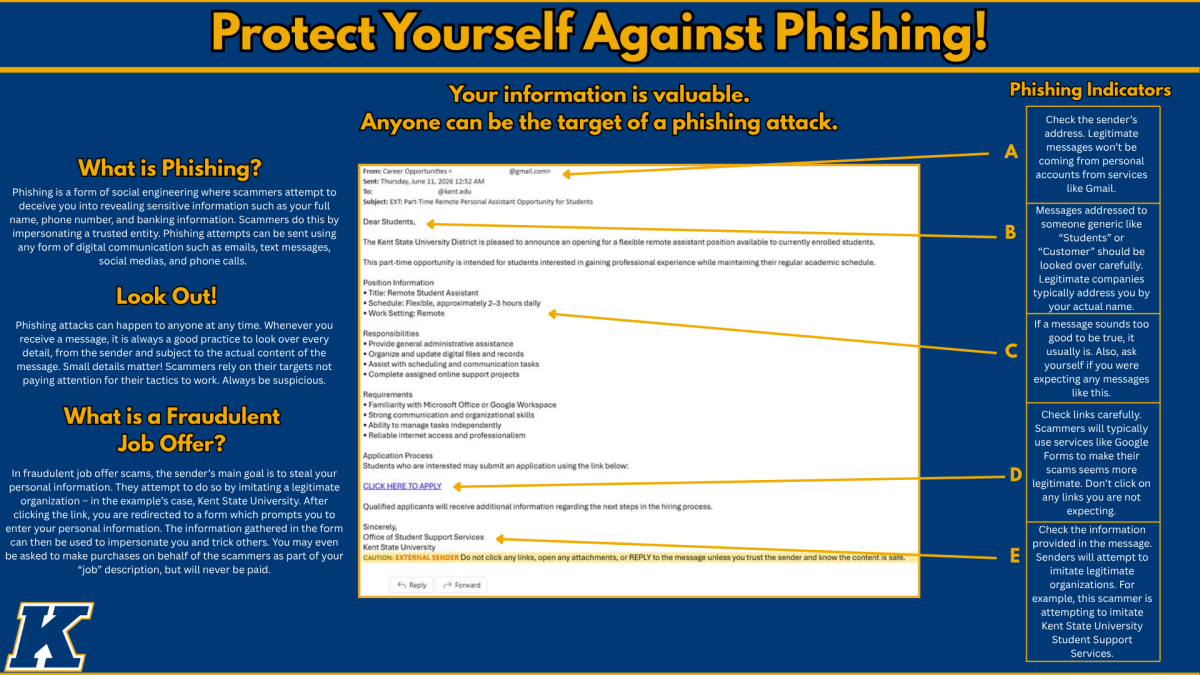
Don't Get Hooked Poster

What Are Scams?

Scams come in many forms and are a type of social engineering to either gain your personal identifiable information (PII), or steal your money. They are getting more and more sophisticated, particularly when it comes to targeting you online and through mobile devices. It鈥檚 important to know how to recognize a scam so you can protect yourself from fraudsters.

Note that KSU will NEVER ask for your password through e-mail, so be wary of anything that says otherwise.

Please report any scams you receive to phish@kent.edu. You can learn about additional ways to report phishing scams here: Report Phishing

How To Detect a Scam?

  • Scammers pretend to be from organizations you know
  • They pretend that you won a prize or that there is a problem
  • Scam calls will usually pressure you to act immediately
  • If it sounds too good to be true, then it probably is
  • Scammers will tell you to pay in a specific way

Steps To Avoid Scams

  • Don鈥檛 give out any personal information
  • Resist pressure
  • Block unwanted calls or messages
  • Don't click on any pictures, links, or white spaces in a suspicious email
  • Stop and talk to someone before taking action or giving out any information

Please refer to the site to read more about common scams and how to report them.


You'd better watch out! 'Tis the season for scams.

HOLIDAY SCAMS ON THE NAUGHTY LIST:

It's always a scramble to find the perfect gift in time for the holidays. Keep in mind - just like the Grinch sitting high up on his mountaintop keeping his eyes on the little town of Whoville, cyber criminals are watching and ready to scam you! Many of us will shop online in search of great deals and to avoid noisy crowds. Unfortunately, cyber criminals will be active as well, creating fake shopping websites and using other tactics to scam people.

With many items being in high demand and slow shipping, you may find yourself in more of a hurry than normal to do your holiday shopping. Unfortunately, this creates the perfect storm for a cyber criminal. They use manipulation tactics and prey on emotions, trying to get your credit card numbers, login credentials and other personally identifiable information (PII)!

How to avoid holiday scams

Win against the scammers graphic.
  • Check every website's URL to make sure that it's legitimate. NEVER enter any sensitive information to a website that does not contain "https" in the web address.
  • Research any company that you don't normally do business with. Check for reviews across the internet.
  • Use a unique password for each of your online accounts.
  • If you purchase from auction or marketplace sites, check the account selling an item. Look for a large number of bad reviews, or no reviews. Always be suspicious of new accounts.
  • Always get tracking numbers so that you can monitor the shipping and delivery process.
  • Never wire money directly to a seller.
  • Do not pay with pre-paid gift cards unless the gift cards are specifically for the site you're buying from.
  • Regularly monitor your credit statements for suspicious charges. Contact your credit card company if anything looks out of the ordinary.
  • If something is too good to be true, it probably is!

Holiday Scams

Around the holidays, scammers get creative with their tactics! Click a topic below to learn about the most common scams of the holiday season, and how to recognize them.

Holiday Scams - Holiday Job Scams

Fake Job Offers During the Holiday Season

During the holiday season, job scams become more prevalent due to the surge in seasonal hiring and the number of people seeking quick, temporary income. Scammers exploit this urgency by posting fake 鈥渉oliday helper鈥 or remote positions that promise fast cash with minimal effort. These schemes often move quickly, use high-pressure tactics, and target individuals who may be less cautious amid the busy season. As a result, the likelihood of encountering too good to be true offers, requests for upfront payments, or false onboarding processes increases significantly during the holidays. A golden rule to follow is, if it is too good to be true, it is. 
 How Does It Work?

Typically, these scams will start with you receiving an email from an account that is designed to look reputable. The subject will encourage you to read the job offer inside, whether the job offer is in an attachment or inside the body of the email message. These job offers often claim that you can work only one or two hours per day and will receive hundreds of dollars in return. The scammer then asks you to click on a link that takes you to a 鈥渏ob application鈥 form. This form may ask for information such as your name, address, bank account information, and even your password.

Do not trust unsolicited job offers. Always ensure that you are verifying every opportunity you encounter when job searching.

Check out our full article on fraudulent job offers for more information about how these scams work! 

Holiday Scams - Brushing

Brushing

Have you ever wondered why packages sometimes randomly appear at your doorstep even though you haven't ordered anything?  Well, you may have been a victim of a brushing scam. Brushing scams happen when you receive a package addressed to you at your home address that you've never ordered. These packages have no return address, leaving you with the option of opening it or throwing it away. Let's say you decide to open it: inside of the package you see a random cheap object, possibly along with a QR code. You might be thinking it was a secret Santa, and someone was thinking of you and bought you a gift. However, in this instance, that is not the case. 
 
In this scam, the scammer finds your home address somewhere online and uses a third-party mailing service to send a random package to it. After sending the package, they typically write a review using your name to boost the statistics on their fraudulent website. This allows them to raise the prices of products they have listed while seeming like a reputable business, scamming the buyers in the process. Raising the prices for others allows them to make a profit, despite sending you a package at no cost to you. 
 
Alternatively, the scammer may attempt to have you scan an included QR code to answer questions regarding the package. However, the QR code will lead to an imitation of a legitimate site that you might be familiar with where you're prompted to sign-in to 鈥渓earn more鈥 about the package. Signing in to the fraudulent website sends your username and password to the scammer, potentially leaving them with access to your accounts. 

So, next time you receive a package that you did not order and doesn't have a return address, please take the time and ask yourself: could this possibly be a brushing attempt? 

Holiday Scams - Package Theft and Missing Packages
Holiday missing package scam graphic.

Missing Package Scam

During the holidays, package and delivery service scams surge in popularity. Package related scams tend to fall into two primary categories: package theft and fake missing package notifications. 

Delivery notification scam calls and messages tend to look like they are coming from a legitimate mail courier, such as the U.S. Postal Service, FedEx, and UPS. When these come in message form, they typically include fake tracking links as well. Never click a link or call back a number from an unexpected delivery notice. Contact the company directly using a verified phone number, email, or website. If you would like to learn more about courier scams, you can visit our article on the topic!  

Stolen packages also become very common around holiday time with an influx of online orders being placed. According to the Office of Inspector General, at least 58 million packages have been stolen in the United States in 2024, costing on average between $50-$204 in value per package.  Always be wary of stolen packages! While it is inconvenient to lose out on an item you have ordered, it can also be a potential sign of identity theft. A few steps that can reduce the risk of having your orders stolen include: 

  • Making your deliveries require a signature before they are left

  • Installing security cameras to monitor drop-off locations

  • Setting up your delivery window to when you know you will be at home 

If you fall victim to a stolen package scam, it is best to report this theft to the merchant and, if necessary, to your credit card company or bank. In some cases, you may be required to file a police report to receive a replacement on your stolen product.  

Holiday Scams - Lotteries and Prizes

Lotteries and Prizes

A graphic warning against scams that are too good to be true.

A popular scam that goes around during the holiday season often comes in the form of unsolicited phone calls, emails, or messages that claim you have won a sweepstake, lottery, or prize. Sometimes, this can extend into claiming to provide heavy discounts on common gift items. Typically, these offers revolve around desirable items such as electronics, cars, or appliances. Remember, if an offer sounds too good to be true, then it probably is! 

In 2024, the Federal Trade Commission received 97,472 reports of this type of scam, resulting in $347 million dollars in losses. Through the first two quarters of 2025, there have been 34,845 reports totaling around an additional $181 million dollars. 

In prize offers presented by scammers, they often claim that you must pay a fee or tax to cover shipping and handling to obtain the prize. In other cases, like lottery and sweepstakes, they may claim that you must pay to increase your chances of winning a prize. It is also important to note that in real sweepstakes and lotteries, the winner is selected entirely by chance. You cannot pay to increase your chances of winning, requesting that someone pays to increase their chances is illegal.  In these scams, it is also common for scammers to request you to provide financial or personal information. This is the biggest red flag! If someone starts asking for these sensitive details for you to obtain a prize or enter a sweepstake or lottery, it is a scam.  

Remember that scammers will do everything they can to trick you into believing that you have won this prize so that they can get something out of you! They do this by impersonating a government official or member of a recognizable organization. They also use tactics like pressuring you to act quickly and making the prize feel exclusive and special. In situations utilizing impersonation, always check the information available to you in the email! The first and easiest place to look is the email address that sent the email, it may be far off or close to the real email, if you are unsure, you can always search for the company鈥檚 email online! If you wish to learn more about these red flags, you can visit our article about those too! 

Holiday Scams - Social Media

Social Media Scams

Each holiday season you can count on social media scams showing up in some form or another.鈥疶hese days, scams come in all shapes and sizes.鈥疐raudsters use major social media platforms to鈥痑dvertise various scams鈥痶o a large audience.  A lot of these fake advertisements are for hot-ticket Christmas gifts at a discounted price; however, these advertisements lead to phony websites where the scam occurs. Other advertisements request donations where scammers pose as fake charities.

Another type of scam that is arising through social media is the advertisement of dangerous holiday-themed apps, especially those geared to younger audiences. Be careful of what you choose to install! The notes that many of these new holiday apps contain malware or collect personal information. If it is your first time hearing about an app that claims to track Santa or partake in other fun holiday activities, make sure you investigate its legitimacy before choosing to download it.

Scammers will also send direct messages, emails, texts, and even phone calls鈥痶o people trying to extract money or personal data which can then be used to access bank accounts and cards. If you believe you have been a victim of fraud, you can visit our webpage on fraud recovery for helpful steps in recovering your information. 
 
"Secret Santa" is a very common social media scam where users recruit others to join a 鈥淪ecret Santa鈥 group with the promise that they could receive gifts from fellow users. There is typically a certain monetary requirement for what you must spend on a stranger on the internet. They have you provide your name, address and email, which opens the door for identity theft. After collecting your information, they request that you recruit your friends as well.

Gift exchange scam examples:

  • Exchanging bottles of alcohol.

  • Submitting your email or username into a list where participants get to pick a name and send money to strangers to "pay it forward."

  • Buying a $10 gift or e-gift card for your "secret recipient."

In all these versions, participants unwittingly share their personal information (name, home address, email, username, payment details, along with those of their family members and friends, and are further tricked into buying and shipping gifts or money to unknown individuals.

If you think it sounds like a pyramid scheme, you鈥檙e right. This scam has been identified by the Better Business Bureau, which released鈥. 

Check out our full article on gift and donation scams to learn more about how these scams work! 

Holiday Scams - Charity

Charity

Sadly, many scammers will capitalize on the goodwill that flourishes this time of year by asking you to make a donation to a charity that does not actually exist. Charity scams involve scammers collecting money by pretending to work for a legitimate cause or charity, or a fictitious one they have created. Often scammers will exploit a recent natural disaster or crisis that has been in the news. They may also play on your emotions by claiming to collect for a cause that will secure your sympathy, for example to help sick children. These scams divert much-needed donations away from legitimate charities and causes. Scammers may set up fake charity drives that will collect donations for any number of causes.

Verify the authenticity of any charity you鈥檇 like to make a contribution to by researching it before you send it any money. Pay special attention to how a charity wants to receive money. Cryptocurrencies or gift cards are red flags. For more information regarding scams that involve gifts and donations, you can visit our page on that subject.

Holiday Scams - Gift Cards

Gift Card Scams

Holiday gift card scam graphic.

Many scammers will try to get you to pay them with gift cards. Scammers love gift cards because they are untraceable, and it is typically impossible to recover the money once a scammer has the card details. Common gift card scams include scammers telling you to pay a fee with a gift card to avoid being in trouble with the government or pretending to be a family member or friend who needs the funds for a specific store.

Remember this one KEY RULE: Whenever someone demands to be paid with a gift card, it鈥檚 a scam.

Holiday Scams - Fake Websites

Fake Websites

Scammers may set up fraudulent websites claiming to sell high-value items at a discount. These sites tend to appear more frequently during the holiday season, as demand for common gift items increases. Some telltale signs of a fake site: The fake site's web address will have an extra number or letter; the site may also have grammatical errors or limited contact information.

The holiday season brings endless emails offering deals, sales and bargains. Be wary of emails with links enclosed. Some may lead to fraudulent websites created by scammers to trick people into downloading malware, making dead-end purchases and sharing private information.

Whenever you receive an email with a link to click, saying that your account has been compromised and requires immediate attention such as a password, BE SKEPTICAL. These links lead to websites are typically part of an elaborate phishing scam.

Not getting what you paid for is a common scam targeting online shoppers. A scammer will sell a product to you and then send a faulty or inferior quality item, or nothing at all. They may also pretend to sell a product just to gather your credit card or bank account details.

Holiday Scams - Travel

Travel Scams

Around this time of year, many people will travel to spend the season with friends or family. This is a prime opportunity for scammers to strike. A scammer may send links to a fake website that claims to be affiliated with a travel agency. The site will offer deals on travel and hotel bookings for a very low price. The website will allow you to "book" these fraudulent flights and hotels by providing payment information. In reality, the deal was simply too good to be true, and the scammer now has access to some of your financial information.

To avoid these types of scams, it is best to use reputable, trustworthy websites to book your flights and hotels. Whenever you find an offer that is unusually inexpensive, stop and verify that the deal comes from one of these safe sites. If it doesn't, it is likely a scam.

Another travel-related scam features a text message, email, or letter stating that you have unpaid tolls, fees, or fines that you accumulated while traveling on toll roads. If the message is fraudulent, you will actually be paying a scammer when you do not owe any real fees. It is critical to verify that the message you received came from a legitimate transportation authority before you pay the alleged fees.

An example of what the toll scam looks like can be seen below. The redacted phone number and malicious website had no affiliation with the Ohio Turnpike.

A text message containing a toll road scam.

Types of Phishing and Scams

Scammers will use many different methods to try and trick you into giving them important information. Click one of the topics below to learn more about phishing techniques, common scams, and additional advice to help keep yourself safe!

  • Scammers will employ various techniques during their phishing campaigns. These are designed to make their attacks more effective, and are often changed depending on the target. Click one of the topics below to learn how to identify and protect yourself from these techniques!

  • There are many different types of online scams that are designed to steal your money, identity, credentials, and other sensitive information. Though some of these scams seem very different from the others, most scams share several common red flags. Click one of the topics below to learn more about how these scams work, and how to protect yourself and others from them!

  • When it comes to phishing, scams, and online security, there's a lot to learn. Knowledge is the best defense against cyberattacks. Click any of the articles below to learn more about a topic of interest!