
University program coordinators face a constant challenge: finding high-quality, real-world environments where students can practice clinical skills while learning to collaborate across professional disciplines.
During the Spring 2026 semester, administrators at Ñý¼§Ö±²¥ State’s Speech and Hearing Clinic in the College of Public Health and Health Sciences (PHHS) successfully solved this puzzle. By expanding its long-standing partnership with the University’s Child Development Center (CDC), coordinators at the Speech Language Pathology (SLP) program designed and executed an immersive, on-campus training program for graduate students.
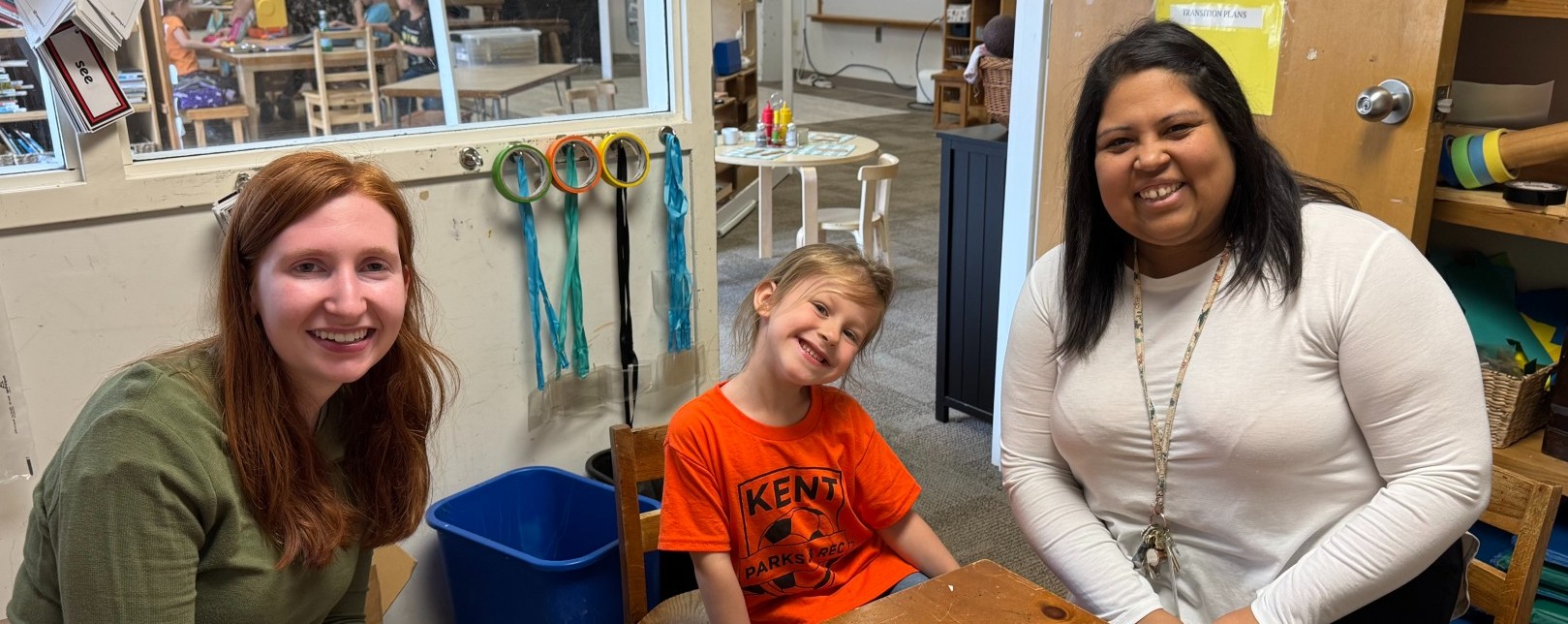
For years, graduate students from Ñý¼§Ö±²¥ State’s SLP program have conducted routine communication screenings at the CDC. But this spring, Associate Lecturers Cara O’Flannigan and Jennifer Visker proactively scaled this relationship into classroom enrichment sessions. O’Flannigan and Visker led the initiative, embedding their graduate clinicians directly into eight CDC classrooms to launch targeted weekly visits focused on early language concepts, reading, and spelling skills.

"The CDC faculty and staff are just terrific to partner with and are always looking for ways to enhance their programming," said O’Flannigan. "Working alongside their team and our dedicated SLP graduate students was an incredibly positive and rewarding experience for everyone involved."
By taking the lead on this collaboration, SLP created a highly effective model that other programs can replicate. For program coordinators looking to build similar, in-depth hubs, the organizational framework offers distinct advantages for student development:
- Authentic Group Facilitation: SLP clinicians transitioned from one-on-one testing to managing real, dynamic classroom groups.
- Interprofessional Collaboration: Organizers built opportunities for students to work directly alongside lead and supporting early childhood teachers, mastering cross-discipline communication.
- Deeper Diagnostic Rapport: Weekly visits allowed SLP students to track development and understand child behavior in a natural environment.
The initiative proved a resounding success for the college. PHHS received overwhelmingly positive feedback from the graduate clinicians, who called the weekly sessions the absolute high point of their semester. Following a return to traditional screenings this fall, organizers in the college of PHHS are already planning to relaunch the enrichment sessions next spring.
"This project provided a profound training environment for our student clinicians," said Visker. "Stepping out of the clinic and into active classrooms challenged them to adapt their skills in real-time, giving them practical, hands-on experience facilitating small groups and collaborating directly with early childhood professionals."
Because the CDC faculty and staff are highly adaptable and eager to enhance their programming, they are an ideal partner for departmental collaboration. PHHS encourages other university program coordinators to take the initiative and propose similar experiential learning ideas.
Partner With the CDC
Other program coordinators in search of securing hands-on, collaborative group hours for students can contact the Child Development Center to explore ideas for mutually beneficial campus collaborations.
To discuss potential student programming, scheduling, or departmental ideas, please reach out directly to Pam Hutchins, M.Ed., school director at phutchin@kent.edu, or call 330-672-2559.
