Ñý¼§Ö±²¥

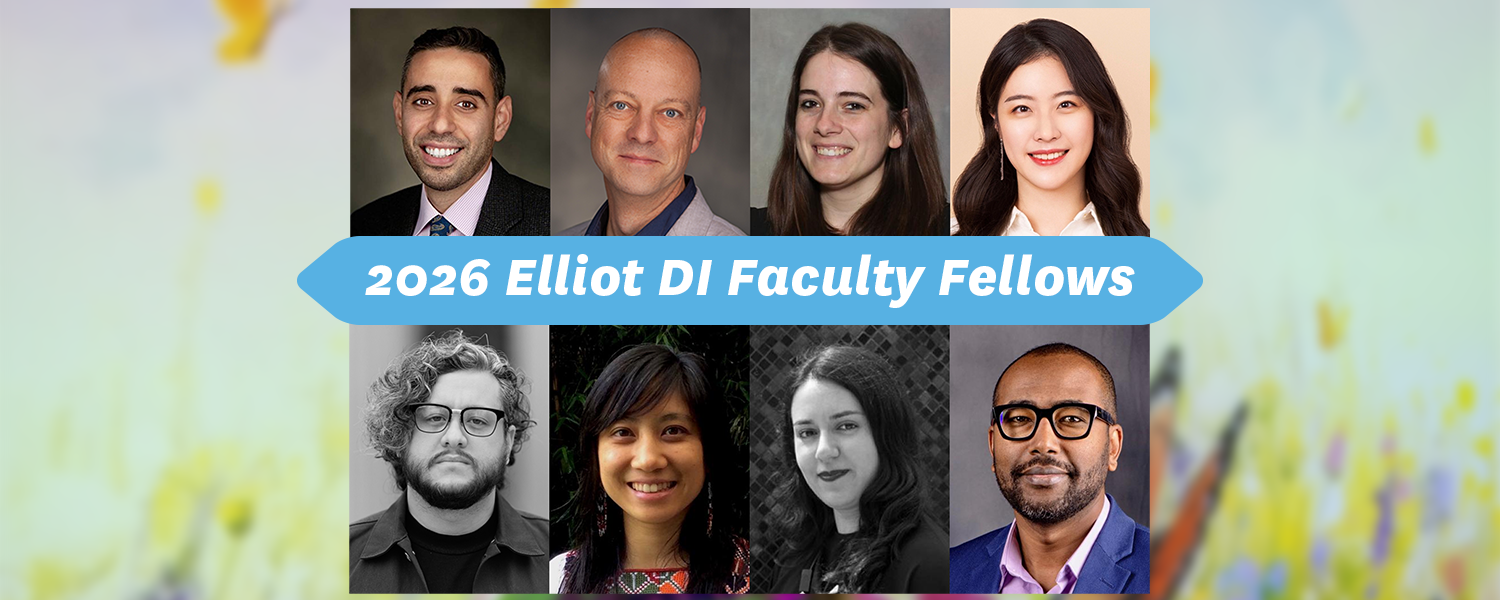
Meet the 2026 Elliot Design Innovation Faculty Fellows

The Design Innovation (DI) Initiative at Ñý¼§Ö±²¥ State University is proud to announce the newest cohort of John and Fonda Elliot Design Innovation Faculty Fellows, an interdisciplinary group of scholars, makers, and educators whose projects explore the intersections of technology, research, and human-centered problem solving.

Supported through a generous endowed gift from John and Fonda Elliot, the Elliot Design Innovation Faculty Fellows Program creates space and time for Ñý¼§Ö±²¥ State faculty from any academic unit to devote a portion of their teaching, research, and scholarly work to collaborative, cross-disciplinary innovation.

Based in the Design Innovation Hub, this six-week summer fellowship engages faculty members in hands-on exploration of human-centered design, collaborative problem solving, and emerging technologies through the Design Innovation Toolkit. Alongside advancing their own projects, DI Fellows build connections across disciplines, engage with the broader DI Ecosystem, participate in guided peer learning experiences, prototype ideas using DI Hub resources, and ultimately earn recognition as a Design Innovation Change Agent.

This year’s cohort represents an extraordinary range of disciplines and project ideas — from lunar habitat design and environmental peacebuilding to robotics education, science communication, and wearable technologies.


Hakim Al Turk

Dr. Abdelhakim (Hakim) Al Turk, Assistant Professor in the College of Aeronautics and Engineering and Elliot DI + Community-Engaged Research Institute Fellow, is exploring how additive manufacturing can be integrated with textiles to create innovative wearable systems. Using flexible 3D-printed materials applied directly to fabric, his project investigates new approaches to wearable technology that enhance comfort, flexibility, and functionality while advancing research in human-centered design and textile innovation.

Jeffrey Balcerski

Dr. Jeffrey Balcerski, Assistant Professor of Aerospace Engineering and former NASA researcher, is examining how future lunar habitats can be designed to support not only human survival, but also human well-being. Through immersive installations and extended reality experiences, his project explores how space environments can better address comfort, mental health, mobility, and social connection in long-duration missions.

Emily Baumgartner

Dr. Emily Baumgartner, Assistant Professor of Emerging Media & Technology, is developing hands-on computer science and robotics workshops for K–12 educators. Using a low-barrier, station-based learning model, her project helps teachers integrate coding, design thinking, and STEM learning into their classrooms while supporting broader efforts to expand computer science education.

Brendan Ho

Brendan Ho and Dr. Elaine (Lan Yin) Hsiao are collaborating on a project that uses human-centered design and maker technologies to support environmental peacebuilding and strengthen community relationships. Together, they will develop modular peace gardens that serve as spaces for dialogue, food cultivation, and community engagement while exploring issues of sustainability, trust-building, and neighborhood resilience.

Elaine (Lan Yin) Hsiao

Brendan Ho and Dr. Elaine (Lan Yin) Hsiao are collaborating on a project that uses human-centered design and maker technologies to support environmental peacebuilding and strengthen community relationships. Together, they will develop modular peace gardens that serve as spaces for dialogue, food cultivation, and community engagement while exploring issues of sustainability, trust-building, and neighborhood resilience.

Taraneh Meshkani

Dr. Taraneh Meshkani, Associate Professor in the College of Architecture & Environmental Design, is investigating how machine learning, computer vision, and immersive technologies can help communities better understand spatial inequalities. By combining data analysis with interactive visualization experiences, her project seeks to make complex information about urban conditions more accessible and actionable for community partners.

Teddy Workneh

Dr. Teddy Workneh, Associate Professor of Global Communication, is launching his Science and Dialogue project to help translate complex scientific challenges into human-centered stories that foster empathy and understanding. Through a proposed "Field-to-Fab" course and an open-source teaching toolkit, he aims to create new models for interdisciplinary science communication and experiential learning.


Innovation Through Collaboration

The Elliot DI Faculty Fellows Program reflects one of Design Innovation’s core beliefs: that some of the most meaningful and impactful ideas emerge when people from different disciplines, perspectives, and lived experiences come together to create. As this year’s Elliot DI Faculty Fellows begin their summer work in the Design Innovation Hub, they join a growing community of faculty innovators using design, making, and collaboration to address complex challenges and imagine new possibilities.

You can learn more about the Elliot Design Innovation Faculty Fellows Program by visiting the Design Innovation website. Throughout the year, the campus and community will have opportunities to engage directly with DI Fellows’ work through the — featuring workshops, exhibits, lectures, and other innovation experiences inspired by these projects. Keep an eye on the event registration page as new events and participation opportunities are announced.

POSTED: Wednesday, June 3, 2026 08:14 AM
Updated: Friday, July 17, 2026 09:10 AM
WRITTEN BY:
Chris Holthe