
GAI Use Disclosure
Transparency can not only help build trust with your students, it can help break down the inaccurate assumptions people are making about others use of GAI.
What & Why
AI disclosure statements or attributions are quick ways to be transparent about our use of GAI. They are becoming a norm and sometimes a requirement in professional arenas. They are meant to describe the role AI played in your work (e.g. editing, brainstorming, drafting). It is not as formal as a citation and its goal is to practice open and honest use of GAI. By practicing this as instructors, we are not only modeling this practice for students but also breaking down inaccurate assumptions students are having about instructor use of GAI.
Please be sure that you are permitted to use GAI for the work you are doing before doing so. There are many publishers, journals and professional organizations that have standards suggestion limited use or no use for different professional activities.
Example Statements
Disclosure statements / attribution statements can be something mentioned in your syllabus, as assignment directions or on individual slides of a presentation. You may choose to use a framework that goes across any use of GAI like "AI Use Disclosure: [insert tool name], [version of tool], [insert how you used it], and [insert human oversight/role/commitment] or more specific ones for different purposes. See examples below for some inspiration and feel free to reach out to the CTL to discuss this further or for your group (15-minute workshops for faculty meetings/instructor gatherings)
- General GAI use syllabus statement: Some course materials have been developed with the assistance of AI tools. All such content has been reviewed and edited by the instructor for accuracy.
- General GAI non-use syllabus statement: I produce all course materials myself, including: lecture notes, test questions, writing prompts and group-discussion guidelines. I make all editing marks and place all comments on students’ written assignments myself.
- Brainstorming statement: I used Gemini to narrow my topic and explore different search terms.
- Research statement: I used Gemini 2.0 on July 5th to help visualize my data. All visuals were analyzed and edited by the author who assumes full responsibility for the final visuals.
- Image attributions can range from minimal to detailed. These are usually found under the image or asterisked to the bottom of a page or footnote. Depending on your purpose and what you hope students might gain from the visual, you can include a variety of information
- Acknowledgement but not specific: This image was generated use GAI
- Specific but minimal: [insert LLM name] generated image
- Specific & detailed: [insert LLM name] generated image with prompt/description: [insert prompt or description provided by GAI]
You may choose to have a longer syllabus disclosure statement to help students better understand your choices or have a conversation with your students. Providing not only what tool you use, why you used it and how you used it can be informative to students, modeling best practices and provide insight into your decision making.
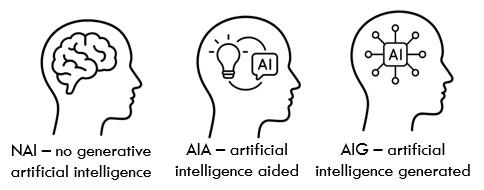
You may also choose to place visual indicators on slides/assignments/course materials. Feel free to use the below visuals and their alt-text.
Resources
The is a tool you can use to help build and organize your disclosure statement.
Read an article from Inside Higher Education entitled "" published on March 30th, 2026.
View statement examples related to different parts of research manuscripts writing from the .
View a that provides sample elements for statements including content affected, action taken, AI tool used, purpose of AI use and human oversight.
